Burning bush Moses: Meaning and lessons from Exodus 3
The burning bush Moses saw was a bush in the wilderness that burned without being consumed. According to Exodus 3, God used this extraordinary sight to call Moses, reveal His holiness, and send him back to Egypt to lead the Israelites out of slavery.
The event was more than a strange natural display. It became a decisive meeting between Moses and God, with lasting meaning for faith, vocation, worship, and courage. Moses approached the bush because it continued burning without turning to ash, and God then addressed him from the fire.
Where the burning bush appears in the Bible
The account is found primarily in Exodus 3:1–22, with the immediate story continuing into Exodus 4. Moses was living in Midian after leaving Egypt. He had married Zipporah, worked as a shepherd for Jethro, and was caring for the flock near Horeb, also called the mountain of God.
At this point, Moses was far removed from his earlier life in Pharaoh’s court. He had been raised in Egypt but belonged by birth to the Hebrew people. After killing an Egyptian who was beating a Hebrew slave, Moses fled when Pharaoh sought to punish him. Years in Midian had given him a quieter life, but the wilderness would become the setting for a much larger assignment.
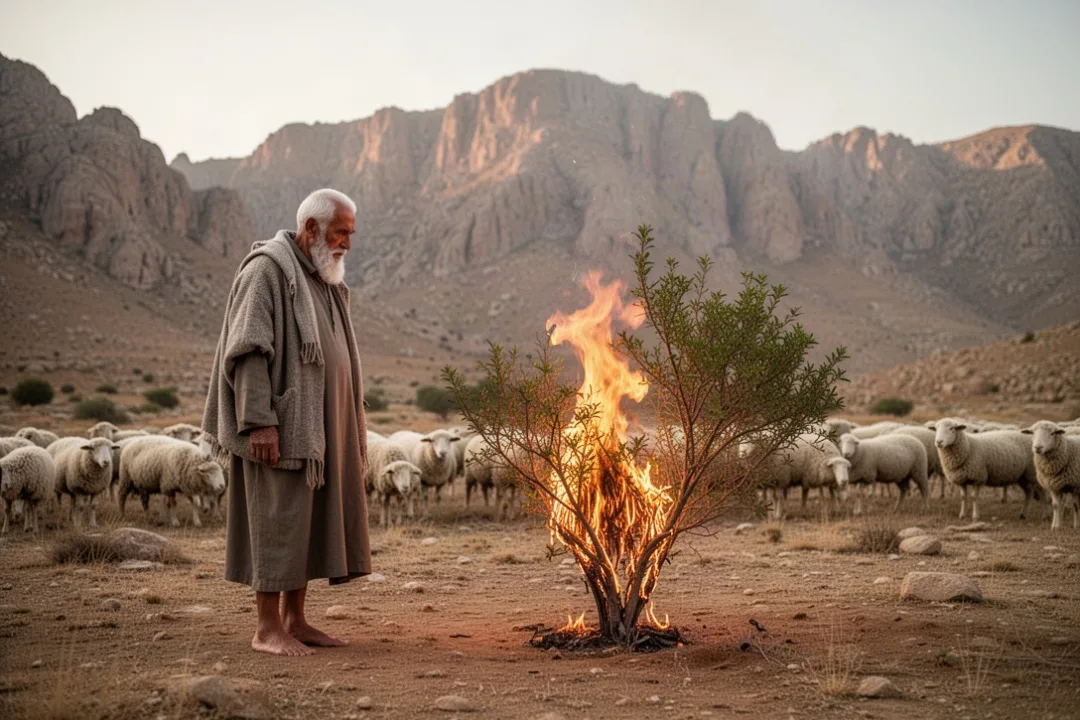
As Moses led the flock toward the remote parts of the wilderness, he noticed a bush that was on fire but did not burn up. He decided to investigate. The scene drew him close, but the voice from the bush stopped him before he came nearer.
God told Moses to remove his sandals because the ground was holy. He then identified Himself as the God of Abraham, Isaac, and Jacob. Moses hid his face, showing fear and reverence in the presence of God.
Why the bush burned without being consumed
The text does not give a separate explanation for every physical detail of the fire. It presents the unconsumed bush as a sign of God’s presence. The flames were visible, powerful, and attention-grabbing, yet the bush remained intact.
Fire often represents divine holiness, glory, judgment, purification, or guidance in biblical imagery. In the burning bush, the fire communicates that God is not ordinary or approachable on human terms. At the same time, God is not distant from human suffering. He speaks from within the created world and draws Moses into a personal encounter.
The bush itself is also significant because it appears ordinary and unimpressive. God did not choose a grand palace, a military camp, or a celebrated monument as the setting for Moses’ call. He used a common plant in an isolated place. This detail has often been understood as a reminder that God can reveal His purposes through humble settings and people who seem unlikely to carry them out.
The scene holds together two truths that should not be separated. God is holy and beyond human control, yet He is also attentive, compassionate, and willing to enter the history of an oppressed people. The fire therefore points both upward toward God’s majesty and outward toward His concern for Israel.
Central idea: The burning bush is not mainly a lesson about unusual vegetation. It is a sign that God is present, holy, attentive to suffering, and able to call an ordinary person into an extraordinary responsibility.
What God tells Moses at the burning bush
God’s message unfolds in several stages. First, He calls Moses by name. Moses answers, and the conversation becomes personal immediately. This is not an anonymous force or an impersonal vision. The God of Israel knows Moses and addresses him directly.
God then tells Moses not to come closer and to remove his sandals. These instructions establish the proper response to holy ground: reverence, humility, and attentive listening. Moses is invited to remain near enough to hear but must recognize that he is standing before someone greater than himself.
Next, God identifies Himself as the God worshiped by Moses’ ancestors. By naming Abraham, Isaac, and Jacob, He connects the present encounter with the covenant story already known to Israel. Moses is not receiving an unrelated spiritual message. He is being drawn into the continuation of God’s promises to the patriarchs.
God also explains that He has seen the suffering of the Israelites in Egypt, heard their cries, and knows their pain. He has come down to deliver them from oppression and bring them toward a good land. The wording shows that the mission begins with God’s compassion, not with Moses’ ambition.
Then comes the assignment Moses does not expect: he must go to Pharaoh and bring Israel out of Egypt. Moses, who had once lived near Pharaoh’s power, is now being sent back as a representative of God. The task is politically dangerous, personally intimidating, and far beyond what Moses believes he can accomplish.
Why Moses reacts with hesitation
Moses does not respond to the call with immediate confidence. His questions reveal fear and uncertainty. He asks who he is to go to Pharaoh and lead the Israelites. He wonders what he should say if the people ask for the name of the God who sent him. Later, he worries that they will not believe him or listen to him, and he points out that he is not an effective speaker.
These objections make Moses a recognizable figure. He is not portrayed as naturally fearless or eager for authority. His earlier failure in Egypt may have left him ashamed, and his long life in Midian may have made returning to Egypt seem impossible. The call disrupts the identity he had built in the wilderness.
God answers Moses’ first concern by promising, in effect, that He will be with him. The answer does not emphasize Moses’ talent, status, or personal strength. It places the foundation of the mission in God’s presence.
When Moses asks what name he should give the Israelites, God gives a profound revelation of His identity in Exodus 3:14. Many English Bibles translate the divine name there as “I AM WHO I AM,” though the exact wording and its relationship to the Hebrew name YHWH involve important translation and interpretation questions. The name conveys God’s self-existence, faithfulness, and freedom from dependence on any created power.
God also gives Moses signs to confirm the mission, including the staff becoming a serpent and then returning to its former state. These signs are not entertainment or magic tricks. They demonstrate that Moses’ authority comes from the God who has sent him.
What “holy ground” means in this encounter
God’s command about Moses’ sandals is one of the most memorable details in the story. The ground is not presented as permanently sacred because of the soil itself. It becomes holy because of God’s presence. The holiness of the place requires Moses to change his posture and acknowledge the One who is speaking.
Removing sandals may express humility and vulnerability. Footwear separates a person from the ground, while removing it places the worshiper directly in contact with the place of encounter. The action also signals that Moses cannot treat this moment casually. He must stop, listen, and recognize that the assignment is being given by God.
The principle extends beyond a particular physical location. In Christian and Jewish reflection, the burning bush often raises questions about how people recognize sacred moments. A workplace, home, church, hospital room, or quiet outdoor place is not automatically equivalent to Horeb. Still, the story encourages attentive awareness that God’s presence can interrupt ordinary routines.
Holy ground does not mean that every unusual experience carries a divine message. Discernment remains necessary. The biblical account connects the sign with God’s revealed character, His covenant promises, His concern for the oppressed, and a mission consistent with His purposes.
How the burning bush reveals God’s character
God sees suffering rather than ignoring it
Before Moses receives instructions, God describes what He has observed in Egypt. He has seen the Israelites’ oppression, heard their cries, and knows their anguish. This language presents God as neither indifferent nor unaware. The deliverance of Israel begins with His attention to people who are being harmed.
That detail gives the story moral weight. The burning bush is not merely a private mystical experience for Moses. It leads toward action on behalf of a suffering community. A spiritual encounter that never addresses injustice would miss a central part of the passage.
God remains faithful across generations
God identifies Himself through the names of Abraham, Isaac, and Jacob. This establishes continuity between the patriarchs and the enslaved Israelites. The covenant has not been forgotten even though generations have passed and the people’s circumstances appear to contradict the promise.
For readers of the Bible, this continuity offers a picture of faithfulness under delay. The passage does not suggest that waiting is easy or that suffering is insignificant. It shows that God’s purposes can continue even when the people involved cannot yet see how those purposes will unfold.
God calls people who feel inadequate
Moses’ doubts are not hidden from the reader. He feels unqualified, worries about credibility, and questions his ability to speak. God does not deny the difficulty of the task. Instead, He gives Moses signs, promises His presence, and provides Aaron as a spokesperson when Moses continues to resist.
This does not mean every personal desire should be labeled a divine calling. It does show that biblical callings often expose a person’s dependence rather than confirming self-sufficiency. Moses’ weakness becomes part of the narrative because the mission will display what God can accomplish through an uncertain servant.
How the burning bush connects to the Exodus story
The encounter prepares Moses for the conflict that follows. He must return to Egypt, speak to the elders of Israel, confront Pharaoh, and lead a people who may doubt him. The conversation at the bush supplies the theological foundation for those later events: God has heard Israel, God will deliver Israel, and Moses will act as God’s appointed messenger.
The burning bush also introduces themes that reappear throughout Exodus. God’s name becomes central when Moses speaks to Pharaoh and the Israelites. The wilderness becomes a recurring place of guidance and testing. Fire later appears as part of God’s manifestation at Mount Sinai, where the covenant is established with Israel.
The story also helps explain the relationship between divine action and human responsibility. God promises to act, but Moses still has to walk back into Egypt, speak difficult words, organize the people, and continue when resistance grows. The call does not remove effort or fear. It gives Moses a reason to move forward despite them.
In this way, the burning bush is both an encounter and a commission. Moses does not remain at the bush permanently. He receives direction and then returns to the difficult place from which he had fled.
What the burning bush can mean for faith today
The story has been interpreted in several complementary ways. It can be read as a teaching about God’s holiness, a revelation of the divine name, a call to serve others, and a picture of grace toward an unlikely leader. These meanings should not be forced into one narrow formula.
For many readers, the passage first asks whether they are willing to pay attention. Moses could have passed the bush without stopping. His decision to turn aside creates the setting for the encounter. Attention does not earn revelation, but distraction can prevent a person from recognizing what deserves careful consideration.
The story also challenges the idea that a calling is validated by comfort. Moses is not promised an easy assignment. He is sent toward Pharaoh, the center of the power that once threatened him. The assurance he receives is not that every obstacle will disappear, but that God will be with him.
Another lesson concerns the difference between humility and avoidance. Moses’ reluctance includes honest self-knowledge, but it also becomes a way to resist responsibility. Humility recognizes limitations while remaining open to obedience. Avoidance uses limitations as a final excuse to do nothing.
Finally, the passage directs attention beyond private spirituality. God’s call to Moses is tied to liberation, justice, community, and the fulfillment of promises. Any application of the burning bush should take seriously the people who are suffering and the responsibilities that may follow from seeing their pain.
Practical ways to reflect on the burning bush
Reading Exodus 3 thoughtfully requires more than choosing a single inspirational phrase. The details work together: Moses’ location, his history, the people’s suffering, God’s holiness, the divine name, and the difficult mission. These questions can help connect the passage with prayer and daily decisions.
- What has gained your attention? Consider the people, responsibilities, or concerns you have been tempted to ignore because they interrupt your routine.
- Where do you need reverence? Identify areas where you have treated God, worship, other people, or your own responsibilities too casually.
- What fear resembles Moses’ fear? Name the specific concern rather than hiding behind a general claim of being unready.
- What action would compassion require? Ask how concern for suffering might become a concrete, wise, and appropriate response.
- What support is available? Moses received help through Aaron and the community. Consider trusted people who can provide counsel, accountability, or practical assistance.
It can also help to read Exodus 3 alongside Exodus 4. The second chapter shows that Moses’ hesitation continues and that the call involves real tension. A balanced reading avoids turning the story into a promise that every difficult decision will feel clear or that every answer will arrive immediately.
Common mistakes when interpreting Moses and the burning bush
The burning bush is familiar, which can make it easy to simplify. Several common mistakes obscure what the passage actually says.
- Treating the bush as the main object of worship: The bush is a sign pointing to God. The story does not present the plant as a deity or as a charm with independent spiritual power.
- Reducing the event to personal inspiration: Moses receives a mission connected to the suffering of Israel. The story is not only about finding personal purpose.
- Assuming Moses felt confident after one conversation: Exodus records continued questions, resistance, and anxiety. A genuine calling can involve an extended process of trust.
- Using “holy ground” to claim that every unusual experience is divine: The passage gives a particular revelation with a clear connection to God’s covenant and character. Discernment matters.
- Ignoring the historical setting: Moses is sent to confront Pharaoh and address slavery. Removing the story from oppression and deliverance weakens its central concern.
- Believing that weakness automatically proves a calling: Moses’ inadequacy does not, by itself, establish his mission. God’s revelation, the signs, the message, and the larger biblical story all matter.
Reading tip: Keep the sign and the assignment together. The fire captures Moses’ attention, but God’s words reveal the meaning: holiness, compassion, covenant faithfulness, and a call to serve.
How different traditions understand the burning bush
In Jewish interpretation, the burning bush is closely connected with the revelation of God’s name and the deliverance of Israel from Egypt. The scene belongs to the foundational story of the Jewish people and points toward the covenant relationship between God and Israel. Jewish readers may also explore the significance of the bush’s lowly form and the way divine revelation occurs in a place of exile.
Christian interpretation commonly reads Moses as a major figure in salvation history and sees the Exodus as an important pattern of deliverance. Some Christian traditions connect the burning bush with themes of divine presence, vocation, and the holiness of God. Later Christian writers have also drawn symbolic connections between the bush and Mary, the church, or the incarnation, though those connections are theological interpretations rather than the direct meaning stated in Exodus 3.
Across traditions, the central features remain recognizable: God reveals Himself, notices the suffering of His people, calls Moses by name, and sends him into a difficult task. The story’s power comes from the unity of those themes rather than from the visual spectacle alone.
What the burning bush teaches about calling and obedience
Moses’ call begins with encounter but must become obedience. He cannot fulfill the assignment simply by understanding the message. He has to leave the wilderness, return to Egypt, speak with Israel’s leaders, and face the ruler he once escaped.
This pattern offers a careful way to think about vocation. A calling may involve work, family responsibility, public service, ministry, advocacy, or a single act of courage. The important question is not whether the task looks dramatic. It is whether the response is grounded in truth, compassion, wise counsel, and a willingness to act faithfully.
The passage also shows that obedience does not require pretending to have no fear. Moses voices his concerns directly. Faithfulness means bringing those concerns to God and receiving help, not creating a false image of confidence. His journey demonstrates that courage can consist of moving forward while still feeling inadequate.
The burning bush therefore remains a vivid image of holy interruption. An ordinary day in the wilderness becomes the starting point for a mission that changes the history of Israel. The fire draws Moses near, the command teaches him reverence, and the call sends him back into the world where suffering demands a response.
Frequently asked questions
Was the burning bush a symbol or a real event?
Exodus presents the burning bush as a real encounter in which Moses saw fire that did not consume the bush and heard God’s voice. Readers differ on how they explain the physical phenomenon, but the biblical emphasis is the divine message: God is holy, knows Israel’s suffering, and commissions Moses to lead the people out of Egypt.
What name did God reveal to Moses at the burning bush?
In Exodus 3:14, God gives a self-description commonly translated as “I AM WHO I AM.” The following passage connects this revelation with the Hebrew divine name often represented in English as YHWH. Translation and interpretation vary, but the name emphasizes God’s identity, independence, and faithfulness.
Why did Moses remove his sandals?
God instructed Moses to remove his sandals because he was standing on holy ground. The action expressed reverence and humility before God’s presence. The holiness belonged to the encounter with God rather than to the plant as an object of worship or to the ground as a magical substance.
What happened to Moses after the burning bush?
Moses returned to Egypt with Aaron, spoke to Israel’s elders, and confronted Pharaoh. The process was difficult: Pharaoh resisted, Moses faced doubt from the people, and the plagues preceded Israel’s departure. Moses ultimately led the Israelites out of Egypt and toward the wilderness as part of the Exodus.